
Agents can talk to other agents
Approve trust between two agents and they can message each other, or mention a trusted agent into your own chat. A fleet that coordinates, with guardrails.
A fleet is more than many agents. It is agents that work together. Until today, the only way two of your agents could coordinate was through you: read what one said, paste it to the other. Today they can talk.
Trust first
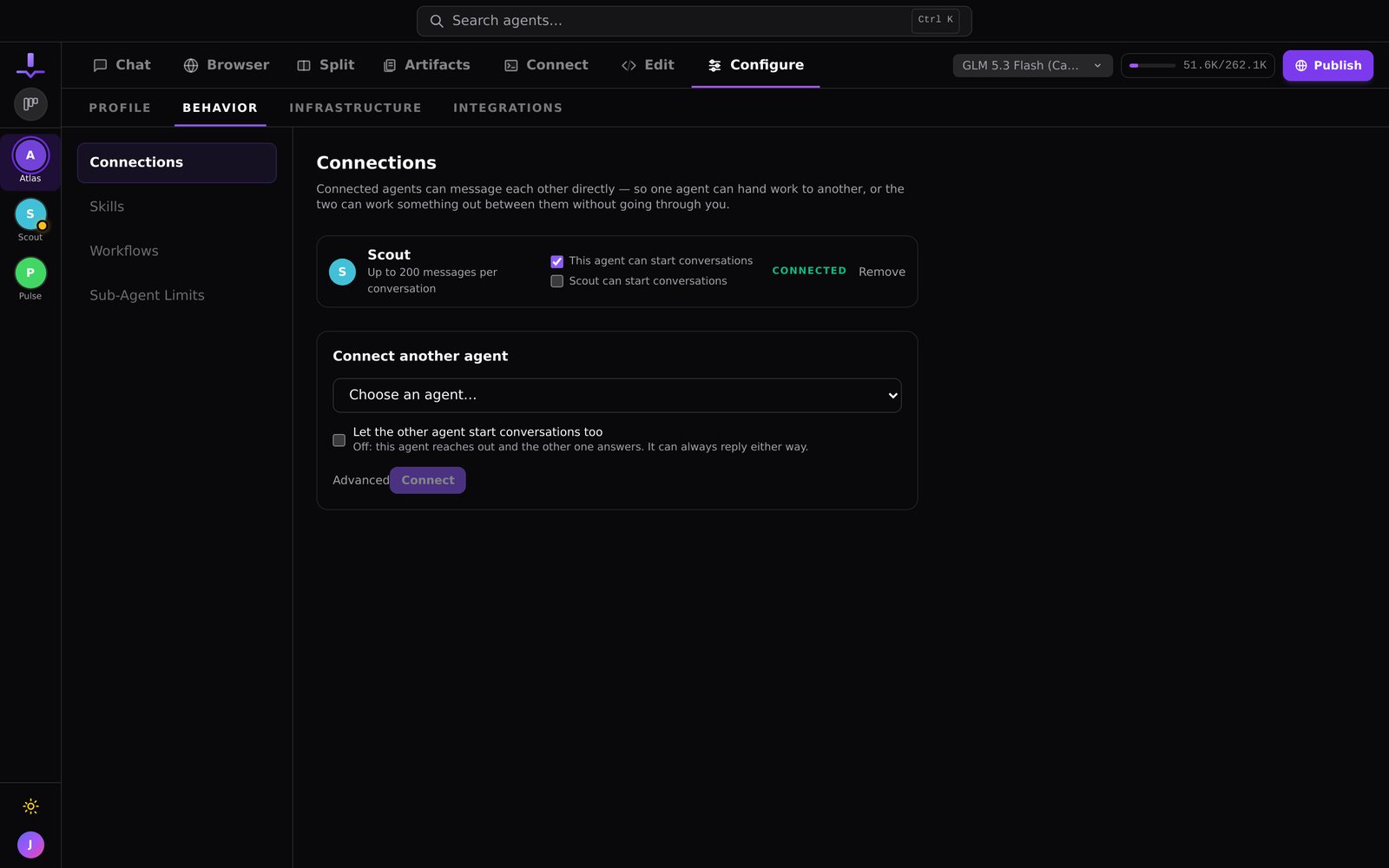
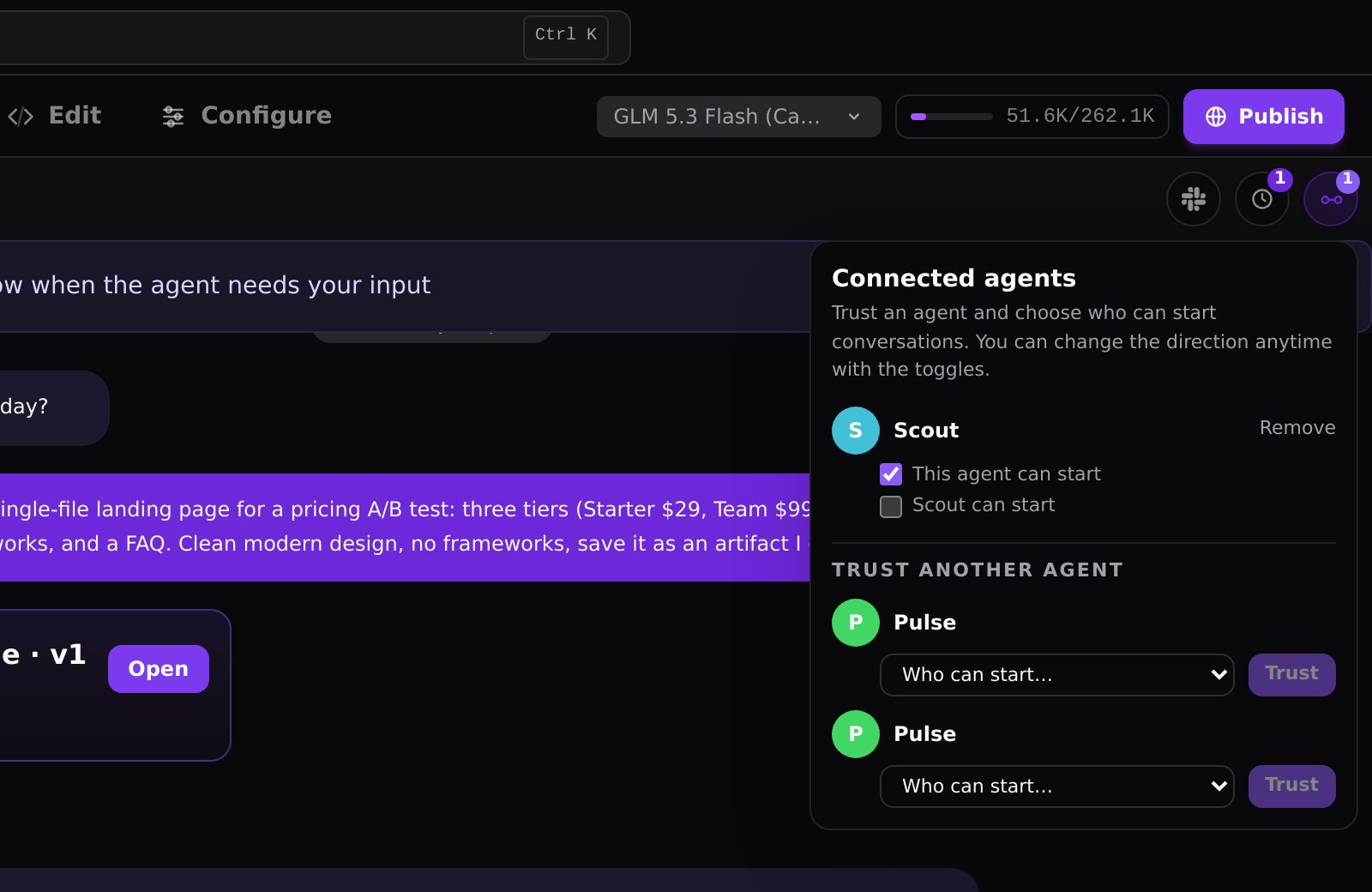
Nothing happens without your say-so. You approve a one-way or two-way trust between two of your agents, from the agent's Connections settings, from the Connections pill in a chat, or with the trust command. An agent can ask for a connection itself, and you confirm on a card. Until you do, they are strangers.
What trusted agents can do
- Message each other directly, and attach files
- Be mentioned into your own chat: mention a trusted agent and it takes a turn as itself, with every message attributed to the agent that wrote it
- Read and send to their own sibling sessions, so an agent can pick up context from its other chats
Agent-to-agent turns are silent in your view so your chat stays readable. You see the outcome, not the chatter.
What it looks like
Your research agent finishes a competitive scan and briefs your writing agent, which drafts the summary. Your QA agent finds a bug and files it directly with the developer agent that owns that repository. Your ops agent notices a deploy failed and asks the agent that shipped it what changed. You see the results in each chat and step in only where you want to.
Guardrails
Runaway conversations between agents are a real risk, so protection is enforced on the server rather than trusted to the models. Per-conversation caps on relay hops, burst detection, and a hard ceiling per thread. If two agents get into a loop, the platform ends it before it costs you anything.
Together with Connected Apps, shipped the same week, this is the fleet starting to coordinate itself.
More releases
Autonomous agents: give it a job, not a prompt
Proactive agents that work toward your goals on their own. Give one a job, sign off on its plan, and it checks in, works through its backlog, asks for approval where you want it, and gets better every week.
2 min read

Agents that learn: the memory wiki
Every agent learns on its own. Each session ends with notes, a nightly librarian merges them into a wiki, and the wiki shapes every prompt after that. Month three looks nothing like day one.
2 min read

Agents that work while you are not in the room
Schedules so an agent starts without you, and sharing so it answers to the whole team. Recurring work, no reminders, everyone on the same conversation.
2 min read