
Run Claude Code or Codex as a daemon, with no server to keep awake
Want Claude Code running in the background without babysitting a daemon? JackHamr hosts the runtime for your Claude Code or Codex subscription on its own cloud machine, and you can steer a running turn mid-flight.
In June we let you bring your own Claude Code subscription. It worked, people loved it, and every one of them had to run a daemon somewhere first. A laptop that had to stay awake. A spare server. A tmux session someone was afraid to close. That requirement is gone.
Managed runtimes
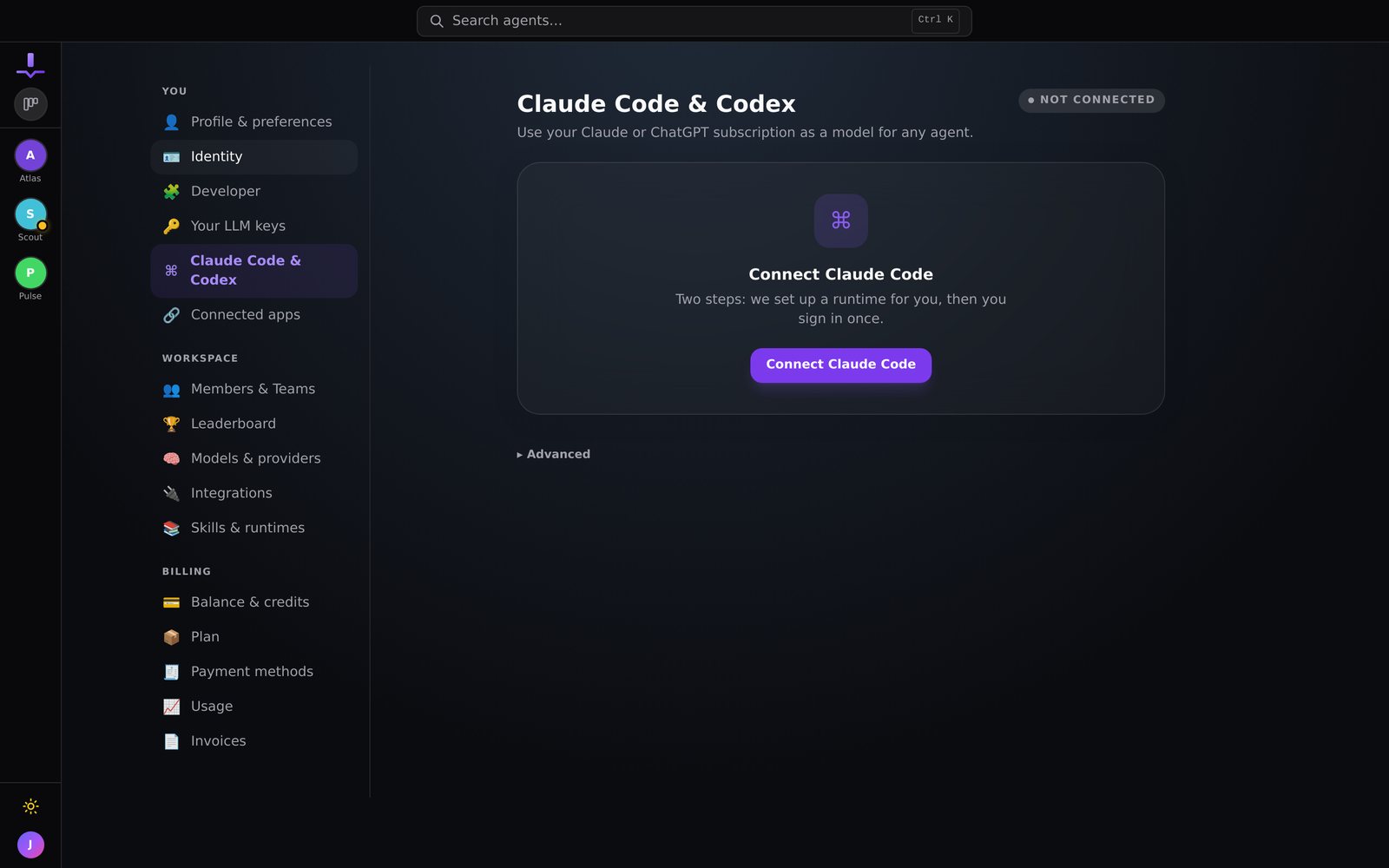
Settings offers a Managed runtime the platform hosts end to end. Ask for one and a small runtime host is provisioned with Claude Code and Codex installed. Sign in from the browser with a link and a pasted code. That is the whole setup, and it costs nothing: the host is free, stays up while any of your agents is running, and sleeps when they are all idle.
Runtimes appear in the model picker once you are signed in, entries lead with the model name, and a Claude Code runtime can be an agent's default brain. Sub-agents and board cards run on it too, so a whole pipeline can use the subscription you already pay for.
Steer mid-run
Send a message while a Claude Code turn is running and it reaches the agent at the next tool boundary, exactly like typing into the terminal while it works. "Skip the tests for now." "Use the other library." The agent adjusts without finishing the whole turn first. Codex got the same behaviour four days later. An Effort pill next to the model picker sets how hard the model thinks for that chat, from minimal to max, and sticks with the session.
The same work removed the speed penalty. Running Claude Code through JackHamr is now as fast as running it directly.
Nothing to host, nothing to keep awake. The subscription you already pay for, running on a fleet. ## Questions people ask about Claude Code daemons
### What is a daemon, in plain words?
A daemon is just a program that runs in the background, with no terminal window and no one babysitting it. "Claude Code as a daemon" means Claude Code keeps running after you close your laptop: it picks up tasks, works on them for as long as it takes, and saves the results. The traditional way to do this is tmux on a server you keep awake. The managed way is to let a platform host the runtime, so there is no server of yours involved at all.
### How do I run Claude Code without a daemon?
If you do not want to run anything yourself, you do not need a daemon at all. Managed runtimes move the whole thing onto a hosted machine: you sign in from the browser, your Claude Code subscription does the work, and the output streams back into the chat. Nothing on your laptop has to stay awake, and nothing to restart after a reboot.
### Does Codex support the same thing?
Yes. The same runtime layer runs Codex as well as Claude Code, with the same mid-run steering: you can watch a turn in progress and send it a message before it finishes, instead of waiting for it to end.
### What is the difference between a runtime and a daemon?
A daemon is the background process pattern; a runtime is the hosted environment the process lives in. In practice: the daemon is Claude Code running with no window, and the runtime is the machine it runs on, with the tools, credentials and memory wired up. JackHamr's managed runtimes give you the second so you never think about the first.
Try it on your own project.
$30 in free credit, no card needed. Your first agent is running the moment you sign up.
More releases
Bring your own Claude Code
Your Claude Code subscription becomes the agent's brain, with the full JackHamr tool surface. Codex followed on July 6. In September it became fully managed.
2 min read
What one AI agent task actually costs, and why long sessions are the budget killer
Plan prices hide the unit that matters: the task. From real production data across hundreds of agents, here is what an agent task costs in machine time, why sessions that run long cost more than they should, and the one ratio that predicts your bill.
3 min read
Google Antigravity alternatives: what to use instead, by what you are trying to do
A field guide to the Antigravity-alternative question. Editor-shaped tools for hands-on coding, autonomous app builders for prototypes, and agent teams for shipping whole features, with the honest trade-offs of each.
6 min read